When I became an Army chaplain in 2010, I was taught that chaplains carry a three-part charge, the core responsibilities that define our ministry: Nurture the Living. Care for the Wounded. Honor the Dead. In 2015, I transferred to the Navy Chaplain Corps, but that charge never changed. Across all branches, military chaplains share this sacred responsibility. Of those three responsibilities, honoring the dead may be the heaviest.
Over the last sixteen years, I have carried out that responsibility through funerals and memorial services, burials at sea, and casualty notifications. Most chaplains who remain in military ministry long enough eventually share these experiences. Few moments compare to standing with a casualty assistance team and approaching a family’s front door, knowing that life will be divided into before and after the moment that door opens. No chaplain wants those moments.
But being present in humanity’s darkest hours is part of the calling.
Memorial Day can feel like a mixed bag in America. For many people, it is simply a long weekend; cookouts, sales, travel, and time with family. There is nothing inherently wrong with gathering and celebrating life. But for others, Memorial Day carries names, faces, empty seats, folded flags, and memories that never really fade.
Years ago, while serving as a base chaplain at Naval Air Station Meridian, I participated in several funerals and memorials for aviators. During one conversation, I asked a squadron commander about the losses the aviation community had experienced. He looked at me and said: “Spend enough time in this job and you will lose people. What we do is dangerous.” He wasn’t being cold. He was being honest.
Military service carries risk – even in training, even in preparation, even far from combat. And yet every day, ordinary men and women raise their right hand and choose to serve something bigger than themselves.
As a Christian, I often return to the words of Jesus: “Greater love has no one than this, that someone lay down his life for his friends.” (John 15:13)
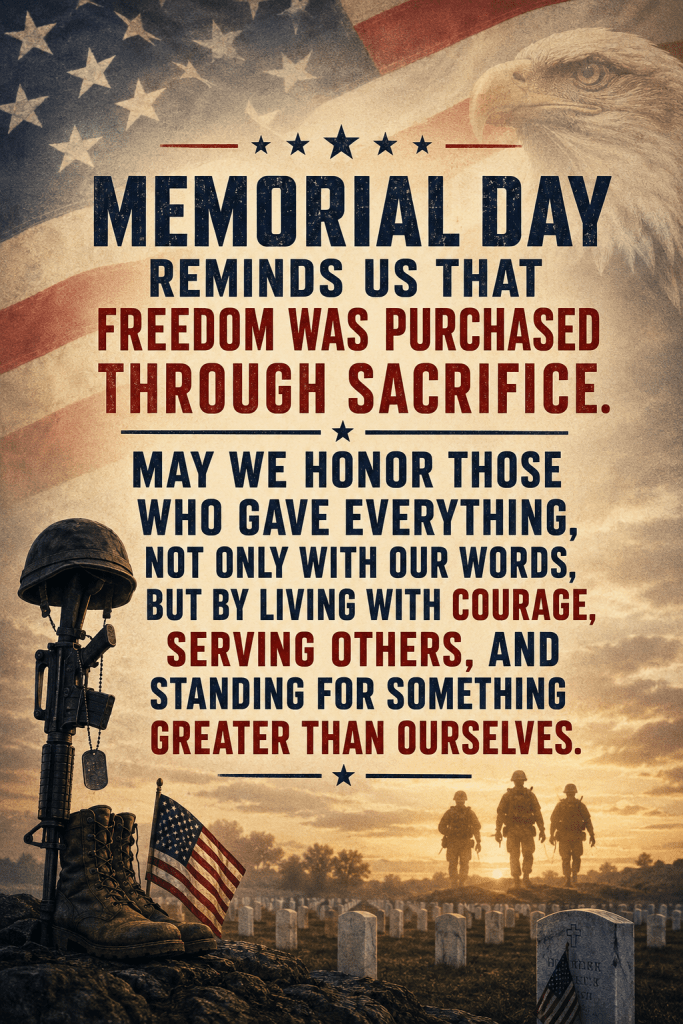
Memorial Day is not ultimately about war. It is not about politics. It is about remembrance. It is about refusing to allow sacrifice to become invisible.
So enjoy your cookout. Spend time with your family. Laugh. Rest. But before the day ends, pause for a moment. Remember those who never came home. Remember the families who carry both pride and grief. Remember those who gave their future so others could live theirs.
And honor them, not only with words, but by living a life worthy of the freedoms they helped preserve.

