America’s founders had experienced the abuses of political and religious powers in the European monarchies, so they attempted to create a new nation that prevented the duplication of those problems. That is why from the very beginning, the United States was not a monarchy, and there would be no official religion. Instead of kings who reigned for life and whose heirs would inherit the throne, we would be governed by elected officials with limited terms of office. Instead of a state religion, the government would be prohibited from establishing an official religion, and would guarantee the free exercise and expression of religious worship and practice for everyone.
Understanding this Constitutional mandate from the start, it is fair to say that even though the United States may have been founded on many biblical ideas and ideals, and even though many, if not the majority, of our citizens were Christians, America itself was designed to guarantee freedom of religious expression for people of every faith and culture. This is the situation in our military, and this is what every good chaplain understands.
Pluralism is foundational, yet it is one of the more difficult issues for many to understand because we’re accustomed to working and ministering in a local congregation where almost everyone we interact with is from our own faith group, with identical doctrines and similar worship styles. The only time many pastors work with someone outside of their faith tradition is when there’s a Community Thanksgiving Service or other city-wide program. Some have never even done that.
But as a military chaplain, every single day you’ll see service members of different faith traditions. You’ll routinely interact with Jews, Catholics, Muslims, Latter Day Saints, Protestants of many varieties, and those with no faith whatsoever. Some chaplains flourish in this kind of pluralistic environment, while others flounder, stick out like a sore thumb, or feel like a fish out of water.
Clergy who come into the military with little ecumenical or inter-faith experience might experience some culture shock. Others might have to learn real fast what it means to be a genuine Christian who is faithful to the Bible and Christian lifestyle, while at the same time working and living side by side with agnostics, atheists, Hindus, cussers, smokers, alcoholics, and blatant sinners.
We are never asked to compromise our own faith and religious values. But at the same time, we have to respect and tolerate everyone else. In fact, part of the chaplain’s job is to make sure each person in the military is afforded the same religious freedom, regardless of what they believe.
In 2013, former Army Chief of Chaplains, MG Don Rutherford, wrote a letter that was included in his Strategic Roadmap for the Army Chaplain Corps. Part of his message said:
A foundational principle of our nation is our country’s reliance on the grace of God. From the very inception of our United States, the preeminent value of the free exercise of religion and the non-establishment of religion has been a bedrock of our Democracy. This tradition stands enshrined in the First Amendment to the Constitution and in the enormous body of documentation penned by our Founding Fathers. To help preserve and defend our right of free exercise is the special mandate bestowed upon the Army Chaplain Corps by the American People.
Chaplain Rutherford, who is a Roman Catholic priest, goes on to refer to today’s military as “the most religiously diverse organization in the world.” This is the environment we are called to when we become military chaplains in the twenty-first century.
As an Army chaplain, I have intervened for my Jewish soldiers whose dietary requirements were not being met. When I fought for a Christian female soldier whose particular organization required modesty and she wanted to wear the long-sleeve physical fitness uniform when everyone else was in short sleeves, the Sergeant Major and the Colonel decided to allow for that exception. I was in the chapel one Saturday taking time to pray and worship when the Catholic priest walked in. Seeing that I played the piano and knowing that his keyboardist had called in sick, he asked if I would play at mass the next day, and I did.
In Iraq, I discovered there were several LDS soldiers and civilians at my FOB, including two or three bishops, but they had no way of knowing there were others of their faith group at the FOB. I introduced them to each other, helped them organize an LDS sacrament service, and provided a place for them to meet. When I was at a large installation in the States, one Sunday morning I concluded worship at the chapel and was greeting people as they filed out the front doors. A man I didn’t know came up to me and asked if I would pray for his husband who was having back surgery in a few days. When I agreed to pray for his husband, he turned and shouted through the crowd, “Honey, the chaplain said he’ll pray for you.”
It is entirely possible to serve others without violating your own convictions. And if the time should come when accommodating someone’s religious request does go against your conscience, you have the right to refer them to another chaplain who can meet their needs.
Here’s the point: military chaplains are called and commissioned to care for all of the personnel in the command. This can be a big ask, but if we are big enough and if our God is big enough, we can love enough to care for people regardless of their culture, tradition, or background.
By CH (COL) Paul Linzey, US Army, Ret.
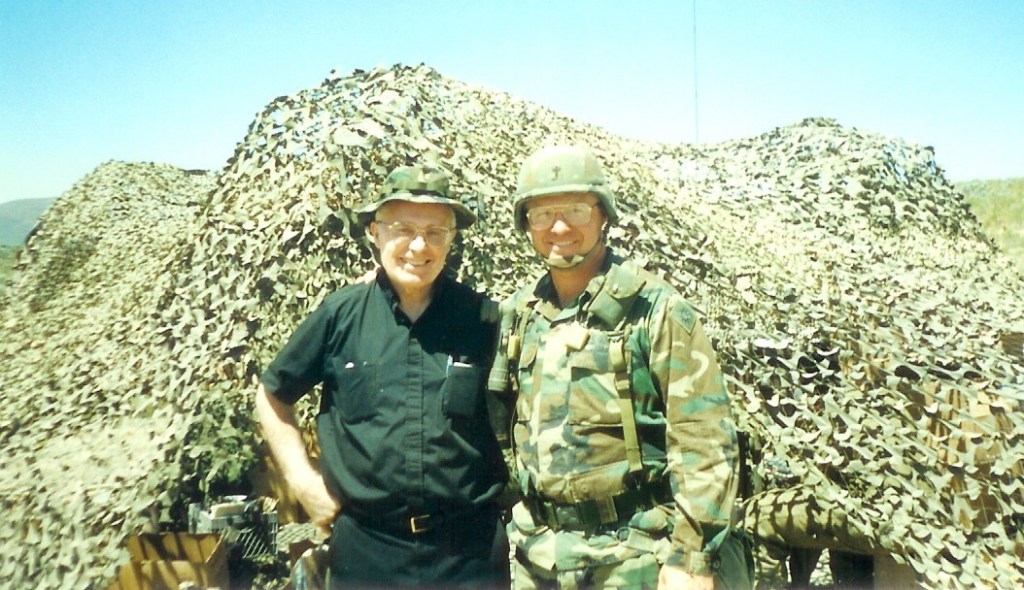
When my infantry battalion had to be away from home for an extended training exercise, I arranged for a Roman Catholic priest to spend a day with me. He conducted twenty-two masses, was badly sunburned, and completely exhausted by the end of the day, but he said to me, “That was the best day of my life.”
 Military Chaplain Guide