
My dad was a Sailor during WWII. After the war, he went to college and seminary while pastoring a church. He became a Navy chaplain when I was three months old and retired when I was in college. What this means is I had a pretty good idea what being a military chaplain would be like before I started.
Some clergy, on the other hand, have no idea what to expect when they come into the chaplain corps. All they know is that God called them to this ministry so here they are, ready to serve, but facing a steep learning curve.
It’s amazing the number of good ministers who leave the military chaplaincy because of disillusionment, unfulfilled expectations, or they feel they don’t fit in. For those reasons, I’d like to offer several suggestions that just might help you hit the ground running.
I want you to experience success and effectiveness from your first day in uniform to the last. And you really can!
With that in mind, I offer ten actions you can take that will help you survive your first year as a chaplain. But more than survive, these steps will help you have the time of your life while fulfilling God’s call to ministry.
Number One: Read books, articles, blogs, regulations, and other materials. Anything you can get your hands on that discusses or describes life and ministry as a chaplain. For starters, you might want to read my memoir, Safest Place in Iraq, or the textbook, Military Ministry. This will provide a really good idea of what it’s like to serve. There are a lot of other great books, also.
Number Two: Watch videos, movies, and shows that portray chaplains in action. Believe it or not, there are some good ones and some bad ones, just like there are some good chaplains and some bad ones. You need to know the difference.
Number Three: Talk to your denomination’s Chaplain Endorsing Agent. They know the ups and downs, the ins and outs, and can talk to you from your faith group’s particular theology and approach to ministry. In fact, your endorser should become your best friend and ally. Trust me on this one: you cannot afford to overlook the importance of a good relationship with your endorser.
Number Four: Make a list of questions and start asking around until you get the right answers. A few years ago, I got a call from a chaplain recruiter who told me, “I have a pastor who is interested in becoming a chaplain, but the guy is wearing me out with his questions! Would you deal with him?” So I called the guy. I told him he and his wife could call me three times a week during working hours and they could email me as often as they wanted, on one condition. I wanted him to collect my answers in a notebook so he could read the information over and over again. He agreed and after about four months, he and his wife had enough information to feel comfortable and confident about resigning their church and coming into the military.
Number Five: Make a List of Fears and Apprehensions. You need to identify your concerns and work through them. Find out whether they are well-founded or irrational. And then determine whether to take the plunge and become a chaplain. This could be the best ministry decision of your life, or it could turn into an absolute nightmare.
Number Six: Find a chaplain and a chaplain spouse to talk with or to interview. Some face-to-face interaction can give you a different kind of feel than reading a book or watching a video. The spontaneity in conversation and the personal nature of it can help you a lot. Perhaps find out when your faith group is having a chaplain seminar or fellowship opportunity and ask if you can go. You never know who you might meet and the ways this might help you.
Number Seven: find a mentor . . . maybe two or three. Someone who you trust, someone who will invest in knowing you, your strengths and weaknesses, and help you navigate the process of becoming a chaplain and then the processes of succeeding once you’re in uniform.
In addition to my endorser, my dad, and my older brother, who was also a chaplain, I was fortunate to come across several other seasoned chaplains who helped me immensely. One was my very first supervisor when I was a rookie chaplain. He came to me one day and said, “Paul, my philosophy of ministry is simple: Ministry Follows Friendship. If you spend time building relationships, your Soldiers will know you love them. They’ll come to you when they need help and when they want to talk about the Lord.” He was right. I learned right from the start that being approachable and friendly just might be more important than anything else.
Number Eight: Get in Shape. I don’t know how many chaplains make the mistake of thinking that being a great preacher, counselor, or program manager is enough. IT’S NOT. Just like everyone else in the military, we have to pass the periodic physical testing. It’s not optional. So if you think God is calling you to be a chaplain, that automatically means God is calling you to get in shape, run, do push-ups and sit-ups, swim, or whatever events your particular service requires.
Number Nine: Unity is essential. Unity with your denomination, unity with your endorser, and if you’re married, unity with your spouse. Serving in the military can be very hard at times, and you have to operate from a foundation of unity with the key people in your life. Where there is unity, you can overcome any difficulty or hardship.
Number Ten: Pray, read the scriptures, and be a worshipper. You have to understand that a chaplain is a spiritual leader, and to fulfill that calling, you have to be strong and deep spiritually.
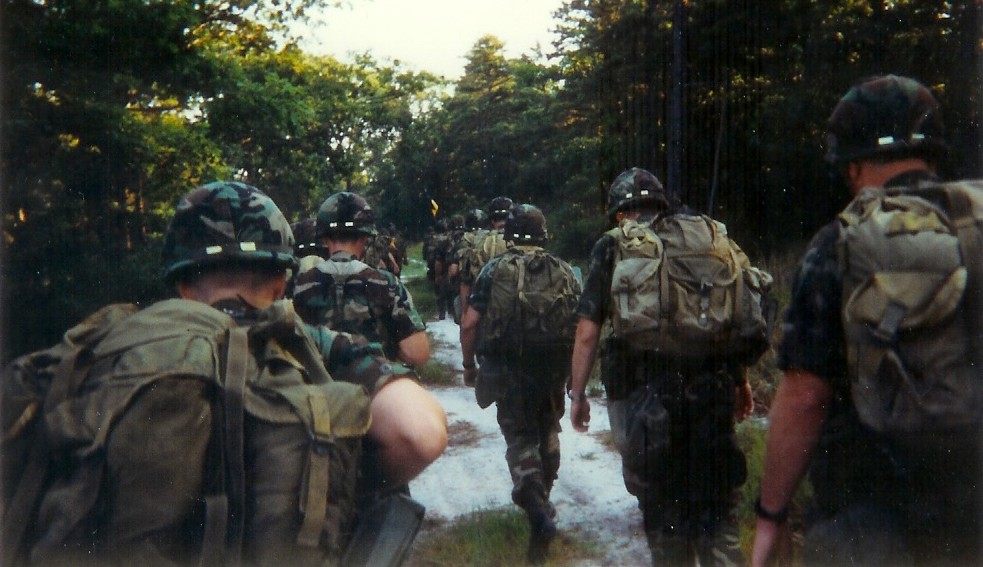
By CH (COL-Ret) Paul Linzey. The picture below is the actual ten-mile march he had to do in the rain as a First Lieutenant during chaplain officer basic course. He took the picture with a disposable camera from the middle of the pack.
 Military Chaplain Guide