
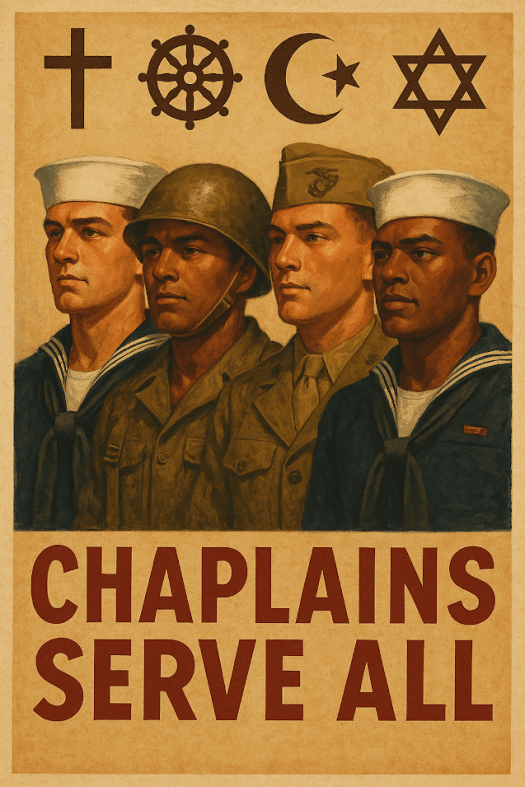
“Pluralism is foundational, yet it is one of the more difficult issues for many chaplain candidates, chaplains, and even some endorsers to understand and discuss because we’re accustomed to working and ministering in a local congregation where almost everyone we interact with is from our own denomination, with identical doctrine and similar worship style.”
In a world where division often seems more prevalent than unity, it’s easy to assume that people are unwilling to cross the lines that separate them. As a Navy chaplain, I know that our role is not to stay within the walls of our own traditions, but to reach beyond them to care for those who may not share our beliefs. Military chaplaincy, in its truest form, demands that we cross these divides, offering support and spiritual care to all Service Members, regardless of their faith.
I experienced this in a very personal way when I was serving as the command chaplain aboard the USS FORT MCHENRY (LSD-43) during a deployment. It was a normal day when a Sailor checked in who identified as a Muslim. He was new to the ship, and when I introduced myself, I offered a simple, “Welcome aboard! I’m your chaplain. If there’s anything I can do to help you, please don’t hesitate to ask.”
His response saddened me a little: “You’re my chaplain too? I thought chaplains only helped Christians. I didn’t think I’d have anyone to turn to since there isn’t a Muslim chaplain onboard.”
Right there I saw how deep the assumption was that chaplains only serve one faith group. That belief can isolate people. But that’s not the role of a chaplain. We exist to bridge those divides, to ensure that every Service Member, regardless of belief, knows that they have someone who cares for their spiritual well-being. I responded, “I’m here for you, too. If you need help finding space for prayer, or if you need assistance with the direction of Mecca while at sea, I’ll can help with that. Just let me know.”
As our deployment continued, we made port in Dubai, part of the United Arab Emirates in the Persian Gulf. It was the month of Ramadan, a time of fasting and spiritual reflection for Muslims around the world. Despite being thousands of miles from home, my Sailor continued to observe the daily fast.
One evening he approached me with a simple invitation: “Would you like to break the fast with me tonight?”
I was honored by the invitation. Here was a Muslim Sailor asking me, his Christian chaplain, to join him in a sacred moment. We left the ship together, picked up traditional food from a local eatery, and shared the breaking of the fast with dates and other foods.
We didn’t debate our beliefs. We did talk about things we held in common: families and life in the Navy. We simply shared time together as two human beings.
That moment reminds me of the heart of pluralism. My own Christian faith was not threatened by my willingness to support and stand beside someone of a different belief. In fact, it was enriched by it. We didn’t try to convert each other. We just shared in an experience that deepened our respect for each other.
One of the greatest privileges of being a Navy chaplain is working with people from a wide variety of backgrounds. I’ve built friendships with those who share my values and with those whose values are radically different. The beauty of it all is that, despite our differences, we remain connected by our common humanity.
As chaplains, we are not called to serve only those who believe as we do. We are called to serve everyone, to help them find meaning and support, regardless of their faith or background.
No matter who you are or what you believe, your chaplain is here for you.
Chris Linzey, Lieutenant, Chaplain Corps, United States Navy
See Chaplain Linzey’s Book “Military Ministry: Chaplains in the Twenty-First Century” on Amazon!
 Military Chaplain Guide